Biohacking Your Fitness in Dubai 2026: Data-Driven Personal Training & Optimization
Welcome to the future of fitness. It’s not about willpower anymore—it’s about optimization.
The smartest fitness enthusiasts in Dubai aren’t relying on gut feeling or Instagram advice. They’re collecting data. Tracking metrics. Using AI. Testing genetic responses. And getting results 3-5x faster than traditional training.
This is biohacking: Using science, technology, and data to optimize your body’s performance and longevity.
In 2026, Dubai has become a hub for fitness biohacking, with 145+ fitness tech companies, advanced wearable integration, genetic testing services, and AI-powered coaching platforms reshaping how people train.
If you’re still training the traditional way, you’re leaving results on the table.
What is Biohacking? (And Why It’s Different)
Traditional Fitness Approach: “Do 3 sets of 10 reps, eat chicken and rice, sleep when you can, hope it works”
Biohacking Approach: “Track recovery data, optimize nutrition at macro and micronutrient level, adjust training based on HRV and readiness, measure progress with precision metrics”
Biohacking isn’t complicated—it’s just applying science to your body.
Core Biohacking Principles:

1. Measure Everything That Matters
You can’t optimize what you don’t measure. The data reveals what works for YOUR body.
Metrics That Matter:
- Heart rate variability (HRV) – Recovery status
- Resting heart rate – Cardiovascular health
- Sleep quality – Recovery indicator
- Blood glucose – Nutrition response
- Strength metrics – Muscle building
- Body composition – Fat vs muscle
- Workout intensity – Training stimulus
- Recovery markers – Readiness to train
2. Personalization Over Generic Programming
Generic programs are called “generic” because they work for nobody specifically.
Personalization Factors:
- Genetics (how your body responds to training)
- Current fitness level
- Goals and timeline
- Lifestyle constraints
- Injury history
- Nutritional tolerance
- Sleep patterns
- Stress levels
3. Iterate & Adjust Based on Data
Test, measure, adjust, repeat. This is the biohacking cycle.
The Process:
- Week 1-2: Establish baseline
- Week 3-6: Train with new variable
- Measure results
- Adjust based on data
- Repeat
4. Use Technology as Your Coach
AI, apps, wearables don’t replace human coaches—they enhance them.
Technology Role:
- Collect continuous data (24/7)
- Identify patterns humans miss
- Adjust recommendations in real-time
- Predict optimal training timing
- Monitor for overtraining signals
Dubai’s Biohacking Ecosystem
The Tech Landscape
As of January 2026, Dubai had:
- 145 fitness & wellness tech companies
- 16 funded companies (totaling $21.5M raised)
- Top startup: LVL Wellbeing (raised $10M)
- Leading investor focus: Wearables, AI coaching, genetic testing
Biohacking Services Available in Dubai
Genetic Testing & Personalization
Services Offered:
- FitnessGene testing (fitness-relevant genetic markers)
- VO2 max genetics
- Muscle fiber type prediction
- Injury risk assessment
- Nutrition response genetics
- Cost: AED 500-1,500 per test
Applications:
- Design training suited to your genetic profile
- Optimize nutrition for your metabolism
- Prevent injuries you’re genetically predisposed to
- Choose sports/training methods that fit your genetics
Dubai Providers:
- Genetic testing clinics in Medical City
- Longevity assessment centers (Downtown, JBR)
- Integrated into amfitpro coaching programs
Wearable Tech Integration
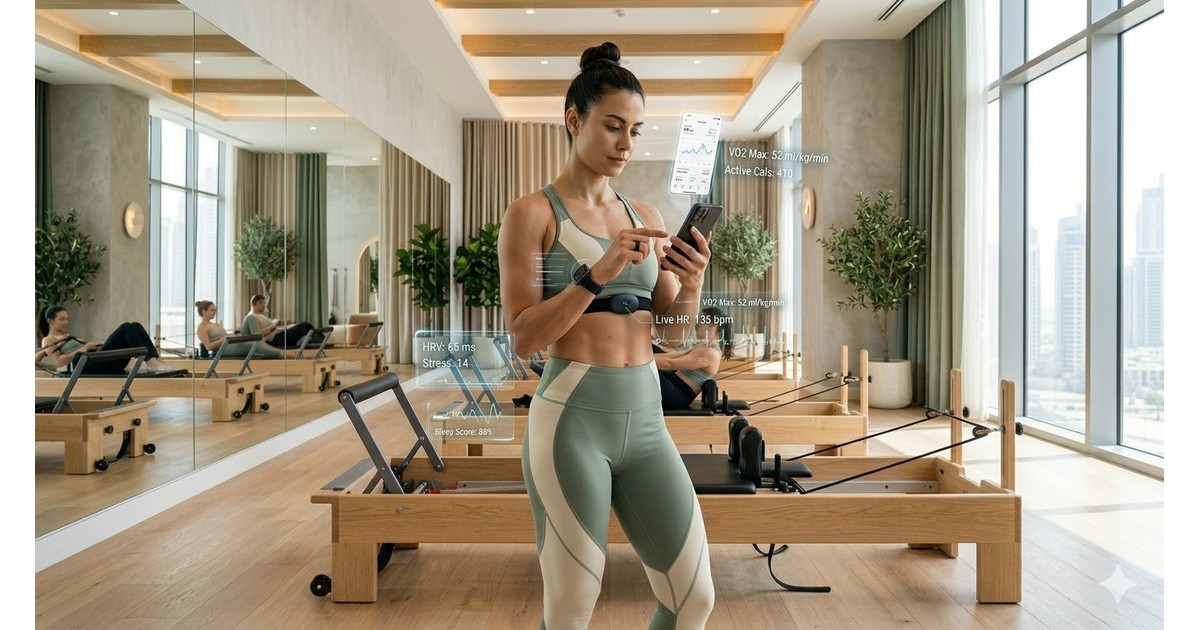
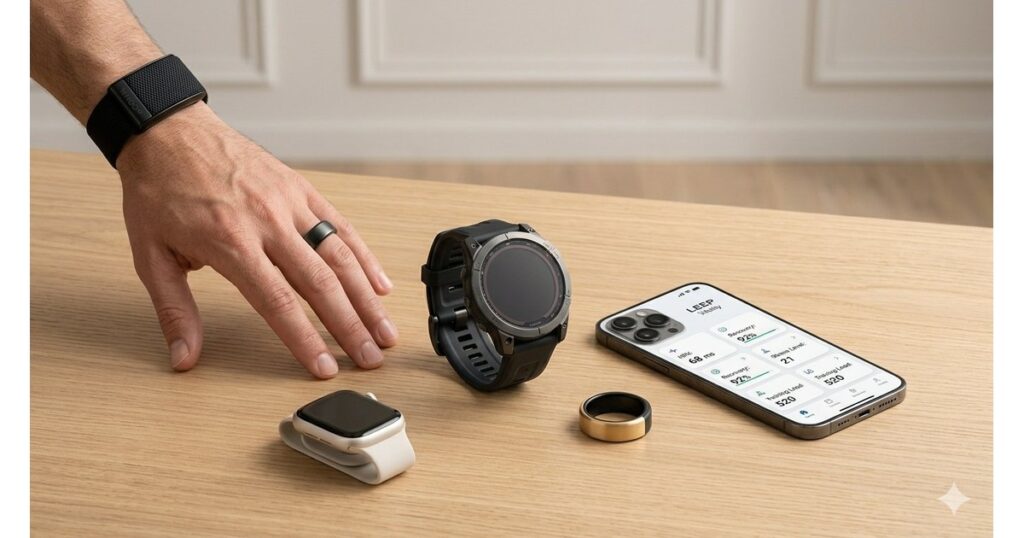
Available in Dubai:
| Device | Cost (AED) | Metrics | Best For |
|---|---|---|---|
| Apple Watch Series 9 | 2,000-2,500 | HR, HRV, sleep, activity | General tracking |
| Oura Ring | 1,800-2,200 | HRV, sleep, recovery | Deep recovery data |
| Garmin Fenix | 2,500-3,500 | Training load, VO2, metrics | Serious athletes |
| Whoop Band | 1,500 + subscription | Strain, recovery, sleep | Real-time readiness |
| LEEP Ring | 1,200 | Recovery, sleep, stress | Affordable biometrics |
What These Track:
- Heart rate variability (HRV) – Single best recovery marker
- Sleep architecture – Deep, REM, light sleep
- Resting heart rate – Cardiovascular improvement
- Body temperature – Training readiness
- Activity levels – Movement patterns
- Stress response – Autonomic nervous system state
- Breathing rate – Recovery indicator
Integrate wearable data with amfitpro coaching
AI-Powered Fitness Coaching
AI Coaching Platforms Available:
Steppi (Dubai-based startup)
- AI-powered training adaptation
- Personalized programming
- Cost: AED 99-200/month
- Why popular: Local, understands Dubai lifestyle
Other Options:
- Tempo AI (home gym integration)
- Fitbod (strength training AI)
- Strong (workout tracking with AI insights)
- Amfitpro’s AI-enhanced coaching
Advanced Testing Available in Dubai
VO2 Max Testing
- Cost: AED 800-1,200
- Measures: Aerobic capacity
- Where: Performance labs in Dubai Healthcare City
- Insight: Training zone optimization
Body Composition Analysis (DEXA)
- Cost: AED 400-600
- Measures: Fat %, muscle %, bone density
- Where: Medical facilities throughout Dubai
- Insight: Strength gain vs. fat loss tracking
Metabolic Testing
- Cost: AED 1,000-1,500
- Measures: Calories burned at rest
- Where: Longevity clinics
- Insight: Nutrition and cardio optimization
Blood Work Biomarkers
- Cost: AED 300-800
- Measures: Hormones, lipids, inflammation markers, glucose
- Where: Diagnostic labs everywhere
- Insight: Nutritional status, training recovery, health markers
Heart Rate Variability (HRV) Analysis
- Cost: Free (with wearable) to AED 200 for professional analysis
- Measures: Autonomic nervous system state
- Tool: Apps or professional interpretation
- Insight: Daily readiness and recovery status
The Data-Driven Training Method
Step 1: Baseline Assessment
Before you optimize, establish where you are.
Essential Baseline Data:
- Fitness level (strength, endurance tests)
- Body composition (weight, body fat %)
- Resting heart rate (measure first thing in morning)
- Sleep patterns (track 1 week)
- Current stress level (subjective scale)
- Nutrition baseline (what you normally eat)
- Injury history
- Genetic profile (if testing)
Get comprehensive baseline at amfitpro.com/assessment
Step 2: Data Collection Infrastructure
Set up systems to collect continuous data without it being burdensome.
Wearable Setup:
- Choose device based on budget/needs
- Wear consistently (24/7 for best data)
- Sync daily to app
- Review weekly trends (not daily variance)
App Integration:
- Training app (Strong, Fitbod, or custom)
- Sleep app (built into wearable)
- Nutrition app (MyFitnessPal or Cronometer)
- HRV app (Elite HRV, Whoop, or wearable app)
- Integration dashboard (if available)
Manual Tracking:
- Workout metrics (weight, reps, RPE)
- Daily energy/mood (1-10 scale)
- Weekly body weight (same time each day)
- Monthly body composition (if access to DEXA)
Step 3: Baseline Interpretation
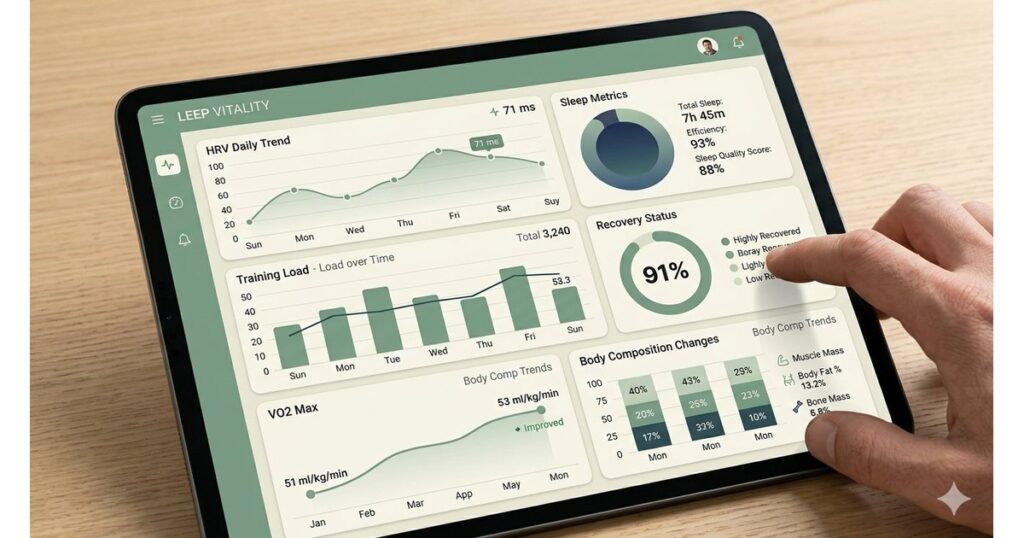
After 2-4 weeks of data, you’ll see patterns.
Key Metrics to Analyze:
Recovery (HRV):
- High HRV = Well recovered, ready for hard training
- Low HRV = Fatigued, need easier session or rest
- Trend = More important than single day value
Sleep Quality:
- 7-9 hours optimal for muscle building
- Deep sleep = Most important phase
- REM sleep = Cognitive recovery
- Track trends week-to-week
Resting Heart Rate:
- Lower = Better cardiovascular fitness
- Baseline: Measure every morning for 2 weeks
- Improvement: 2-5 bpm decrease over months = significant fitness gain
Body Weight & Composition:
- Weight fluctuates 1-2kg daily (water, food, sleep)
- Look at weekly average, not daily
- Body composition changes more slowly (weeks to months)
- Fat loss + muscle gain = weight might not decrease
Training Metrics:
- Strength gains = Weight increasing or reps increasing at same weight
- Endurance gains = Same distance/time becoming easier
- Progressive overload = Essential for results
Step 4: Optimization & Iteration
Based on baseline data, optimize key variables.
Sample Optimization Cycle:
Weeks 1-4: Training Frequency Test
- Current state: 3 days/week training
- Test: What if we increase to 4 days/week?
- Measure: Recovery metrics, energy, progress
- Decision: Does 4x/week improve results without excess fatigue?
Weeks 5-8: Nutrition Variable Test
- Current state: Macros unknown
- Test: Track macros at 1.6g protein per kg bodyweight
- Measure: Strength gains, body composition changes, energy
- Decision: Does this protein level improve muscle building?
Weeks 9-12: Sleep Optimization Test
- Current state: Averaging 6.5 hours
- Test: Target 8 hours for 4 weeks
- Measure: Recovery metrics, energy, training performance
- Decision: Does extra sleep improve results?
The Pattern: One variable at a time, 4-week cycles, measure results, adjust accordingly.

Practical Biohacking Strategies
Strategy 1: Optimize Your Training Windows
Using HRV data to train when you’re most recovered.
Application:
- Check HRV every morning
- If HRV is high (>50 or personal baseline+10): Train hard
- If HRV is low (<40 or personal baseline-10): Light day or rest
- This prevents overtraining and maximizes results
Real Example: Sarah trains 4x/week but only 3 are hard. Using HRV, she trains hard ONLY when recovered, soft days when HRV is low. Result: Better progress with less fatigue.
Strategy 2: Nutrient Timing Based on Training Data
Using workout metrics to time nutrition optimally.
Pre-Workout (1-2 hours before):
- Carbs: 30-40g (based on training intensity planned)
- Protein: 10-20g
- Fat/fiber: Minimal (digestion energy)
Post-Workout (within 1 hour):
- Protein: 30-40g
- Carbs: 40-60g (more if intense training)
- Creatine monohydrate: 5g daily
- Electrolytes: Especially if sweaty session
Customization: Track how different timings affect energy, performance, and recovery. Adjust based on YOUR data.
Strategy 3: Sleep Optimization for Muscle Building
Sleep is where adaptation happens.
Biohacking Sleep:
- Measure sleep for 2 weeks (establish baseline)
- Target 7-9 hours minimum (measure using wearable)
- Track how sleep affects HRV, mood, training performance
- Optimize: Temperature (65-68°F ideal), darkness, no screens 1 hour before bed
Expected Result: Better sleep → Better HRV → Better training ability → Faster results
Strategy 4: Use Technology for Accountability
Shared data creates accountability.
Options:
- Share workouts with coach (they see data in real-time)
- Use amfitpro’s coaching platform for integrated tracking
- Connect wearable to coach (they monitor recovery)
- Weekly review calls discussing data trends
Impact: Data-based accountability > Willpower-based accountability
Strategy 5: Genetic Insights for Programming
If you’ve done genetic testing, use it.
Example Scenario: You’re genetically predisposed to Type 2a muscle fiber (fast-twitch, power-oriented).
Optimization:
- Train with heavier weights, lower reps (plays to strength)
- Include more power work (jumps, explosive movements)
- Less benefit from pure endurance training (genetics work against you)
- Tailor nutrition: Carbs around training (efficient carb utilization)
Result: Programs aligned with genetics produce faster results than fighting against genetic predisposition.
Common Biohacking Mistakes
❌ Mistake 1: Too Much Data, Analysis Paralysis
Tracking 20 metrics and not knowing which ones matter.
Fix: Track 4-5 key metrics only
- HRV
- Sleep quality
- Training performance
- Body weight (weekly average)
- One subjective (energy 1-10)
❌ Mistake 2: Not Allowing Enough Time for Iteration
Changing variables every week instead of 4-week cycles.
Fix: 4-week minimum per variable, then measure before changing
❌ Mistake 3: Chasing Technology Over Fundamentals
Expensive wearable but sleeping 5 hours, eating garbage.
Fix: Master basics (sleep, nutrition, consistency) THEN add tech
❌ Mistake 4: Ignoring Qualitative Data
Only tracking numbers, ignoring how you actually feel.
Fix: Combine biometric data (numbers) with qualitative data (how you feel)
❌ Mistake 5: Private Data, No Accountability
Collecting data but not sharing with anyone.
Fix: Work with coach who reviews your data
Biohacking Startup Ecosystem in Dubai
Top Fitness Tech Companies in Dubai
Steppi (Fitness AI)
- Focus: AI-powered training adaptation
- Founded: 2020
- Status: Funded, actively growing
- Service: Mobile app with AI coaching
- Integration possible with amfitpro
LVL Wellbeing
- Focus: Comprehensive health optimization
- Funding: $10M (highest-funded in Dubai)
- Service: Lab testing, personalized recommendations
- Model: Data-driven health platform
Other Notable Companies:
- Recovery tech startups (sleep, cold therapy)
- Nutrition optimization apps
- Workout tracking platforms
- Wearable integrations
What This Means: Dubai has cutting-edge fitness tech. You have access to tools that didn’t exist 5 years ago.
Building Your Biohacking Protocol
Phase 1: Foundation (Weeks 1-4)
Minimal Tech:
- Start wearable (smartwatch or ring)
- Track sleep 1 week
- Establish baseline resting heart rate
- Measure body weight (daily, look at weekly average)
- Start training with one program
Investment: AED 1,500-2,500 (wearable device)
Goal: Establish baseline data
Phase 2: Optimization (Weeks 5-12)
Advanced Tech:
- Add HRV app (Elite HRV or Whoop)
- Integrate training data (Strong app)
- Track nutrition macros (1 week to establish baseline)
- Consider VO2 max or body composition testing
Investment: AED 500-1,500 (testing + subscriptions)
Goal: Identify patterns, optimize one variable
Phase 3: Advanced (Weeks 13+)
Full Protocol:
- Genetic testing (optional but valuable)
- Quarterly blood work (comprehensive panel)
- Monthly body composition scans
- Work with data-driven coach
- Continuous iteration and optimization
Investment: AED 2,000-4,000 per quarter
Goal: Sustained optimization, peak performance
Integration With Traditional Coaching
Data without guidance is just numbers. Guidance without data is guessing.
The Ideal Model:
- You collect data (wearables, apps, testing)
- Coach interprets data
- Coach adjusts programming based on trends
- You train on the optimized program
- Data improves, coach refines further
- Loop repeats
This is how amfitpro’s online coaching works
The Reality of Biohacking
What It Can Do: ✓ Optimize your training by 20-30% ✓ Prevent overtraining injuries ✓ Identify what works for YOUR body ✓ Accelerate progress ✓ Provide accountability through data ✓ Make training more efficient
What It Can’t Do: ✗ Replace hard work and consistency ✗ Make training enjoyable if you hate it ✗ Compensate for poor nutrition (data without action = useless) ✗ Make results come faster than your body allows ✗ Work without commitment
The Truth: Biohacking is optimization of a system that requires consistent effort. You still have to show up and do the work. But the work will be smarter, more efficient, and more targeted.
Your Next Steps
- Get a wearable (Apple Watch, Oura Ring, or Whoop Band)
- Establish baseline (1-2 weeks of data)
- Choose one metric to optimize (usually sleep or HRV)
- Connect with a data-driven coach
- Start iterating (4-week cycles of test and measure)
Resources & Tools
- WHOOP Band – Recovery platform
- Oura Ring – Sleep & HRV tracking
- Elite HRV App – HRV analysis
- Strong App – Workout tracking
- MyFitnessPal – Nutrition tracking
- Garmin Connect – Wearable ecosystem
Ready to Biohack Your Fitness?
The tools are available. The science is proven. The only missing piece is action.
Start your data-driven journey at amfitpro.com and optimize your fitness like the smartest people in Dubai.
Your body has data to tell. Time to listen.